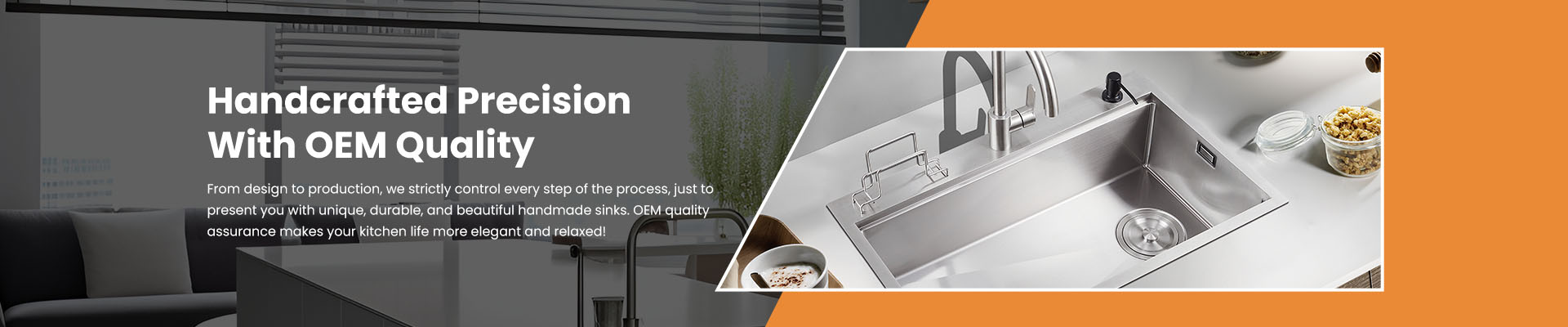
A hand made sink is a sink produced from stainless steel sheet through individual cutting, bending, welding, grinding, and surface-finishing processes. It is commonly called a Handmade Sink, fabricated sink, or hand-welded sink.
The term does not mean that every stage is completed without machinery. Laser cutting, bending equipment, welding tools, polishing machines, and inspection instruments may all be used. The handmade description mainly refers to the way separate sheet sections are formed and joined rather than pressed into shape by one large stamping mold.
This manufacturing method makes it easier to develop square bowls, sharp internal lines, deeper basins, customized dimensions, and special drain positions.
A handmade sink normally passes through several stages.
The production team selects stainless steel sheet according to the required material grade, thickness, surface condition, and finished design.
Kitchen models are commonly produced from 304 stainless steel because it offers a practical balance of corrosion resistance, formability, appearance, and cleaning convenience.
The sheet is cut according to the sink drawing.
Cutting accuracy affects:
Final dimensions
Corner alignment
Drain position
Rim width
Installation fit
Bowl symmetry
The cut sheet is bent to form the basin walls, bottom, flange, and other structural sections.
Accurate bending helps maintain:
Straight rim lines
Consistent bowl depth
Square corners
Flat mounting surfaces
Stable cabinet fit
The corners and structural joints are welded together.
This is one of the most important stages because poor welding can create:
Leakage
Heat distortion
Uneven seams
Surface discoloration
Weak corners
Difficult polishing
The visible welds are ground and blended into the surrounding surface.
The bowl may then receive:
Fine brushing
Satin finishing
Polishing
Gunmetal gray treatment
Black titanium treatment
Other customized surface processes
The finished sink should be checked for:
Dimensions
Flatness
Drain position
Surface consistency
Sharp edges
Weld appearance
Leakage
Packaging protection
A stamped sink is generally pressed from a complete stainless steel sheet using a mold.
A handmade sink is cut, bent, and welded into shape.
Squarer internal geometry
Greater size flexibility
Easier drain-position adjustment
Deeper bowl options
Custom rim structures
Smaller development quantities
Multiple surface choices
Rounded internal corners
Consistent high-volume forming
Fewer welded bowl corners
Efficient production after mold development
Suitable for standardized projects
Smooth curved transitions
Neither process is automatically better for every order.
Stamped sinks are efficient for stable standardized volumes. Handmade sinks are valuable when dimensions, bowl layouts, finishes, or installation details require more flexibility.
The basin is formed from folded and welded sheet sections rather than stretched deeply inside a rounded mold.
This allows the designer to create:
Straight bowl walls
Small corner radii
Flat bottom areas
Rectangular shapes
Defined ledges
Integrated accessory levels
The geometric appearance suits modern kitchens, but very tight corners also require careful cleaning and finishing.
Strength depends on more than the manufacturing name.
Important factors include:
Stainless steel grade
Sheet thickness
Welding quality
Corner construction
Bottom reinforcement
Rim design
Installation support
Bowl size
A poorly welded thick sink can perform worse than a correctly manufactured thinner model.
Buyers should review the complete structure instead of assuming that every handmade sink is automatically heavy-duty.
Material thickness influences:
Rigidity
Dent resistance
Product weight
Welding behavior
Sound
Shipping cost
Installation support
Thicker material may create a more solid feel, but it also increases weight and material cost.
The correct thickness should be selected according to the bowl size, installation method, product position, and target market.
Our handmade sink collection includes single-bowl structures, customized kitchen sinks, hand-welded models, and products designed for different countertop layouts.
Selected products support:
304 stainless steel
Custom dimensions
Brushed finishes
Gunmetal gray finishes
Black titanium finishes
Hand-welded construction
Single-bowl layouts
OEM and ODM development
For example, our stainless steel handmade sink can be discussed with customized dimensions, colors, surface treatments, and packaging.
Handmade sinks are commonly selected for projects requiring:
Non-standard cabinet sizes
Deep single bowls
Square modern styling
Customized drain openings
Accessory ledges
Special countertop reveals
Small or medium product development
Coordinated surface finishes
They can be suitable for residential kitchens, apartments, cafés, bars, hospitality projects, and selected commercial preparation areas.
A handmade sink can require more production time and manual control than a standard stamped model.
Potential challenges include:
Higher labor input
More welding inspection
Greater sensitivity to heat distortion
Surface variation if finishing is uncontrolled
Higher unit cost for some structures
More detailed sample approval
Consistent production requires clear drawings, process standards, and inspection criteria.
Before approving a handmade sink, inspect:
Material specification
Actual sheet thickness
Outer dimensions
Internal bowl dimensions
Corner radius
Rim flatness
Drain position
Weld quality
Brushed direction
Surface color
Bottom slope
Accessory fit
Installation structure
Carton protection
The sample should be tested with water and checked against the actual cabinet and countertop plan.
Our factory integrates sink development, sheet processing, bending, welding, surface treatment, assembly, and inspection.
Before production, our team can review:
Drawings
Samples
Cabinet sizes
Countertop openings
Bowl depth
Drain location
Installation method
Finish
Accessory requirements
Packaging
This helps reduce countertop mismatches, uneven reveals, drainage conflicts, and repeated modification after delivery.
A handmade sink is a stainless steel basin formed by cutting, bending, hand welding, grinding, and finishing sheet material.
Its main value is not simply that it involves manual work. Its value lies in design flexibility, customized dimensions, defined geometry, and the ability to produce sink structures that may be difficult to achieve through standard stamping.
Provide your sink dimensions, bowl depth, corner radius, material requirement, surface finish, drain position, installation method, accessories, packaging, and estimated quantity. We can review the design and prepare a customized manufacturing proposal.
Previous: How Do I Make My Own Portable Sink?