Baking soda is a mildly abrasive household cleaning material that can help loosen light grease, food residue, and surface marks.
It can be useful on many uncoated Stainless Steel Sinks when applied gently, but it is not suitable for every sink material or decorative finish.
Before cleaning, identify whether the sink is stainless steel, copper, natural stone, composite granite, ceramic, enamel, or coated metal.
Baking soda may be used for routine cleaning of many standard stainless steel sinks.
It should first be tested on a hidden area when the sink has:
A colored PVD finish
An anti-fingerprint coating
A polished mirror surface
A decorative coating
An unknown surface treatment
A manufacturer warranty with specific care rules
Remove dishes, racks, sponges, and food residue.
Rinse the bowl with warm water so loose particles do not scratch the surface during cleaning.
When the sink contains heavy oil, begin with mild dishwashing liquid.
Baking soda works better after the oily film has been reduced. Rinse away the detergent before applying the powder.
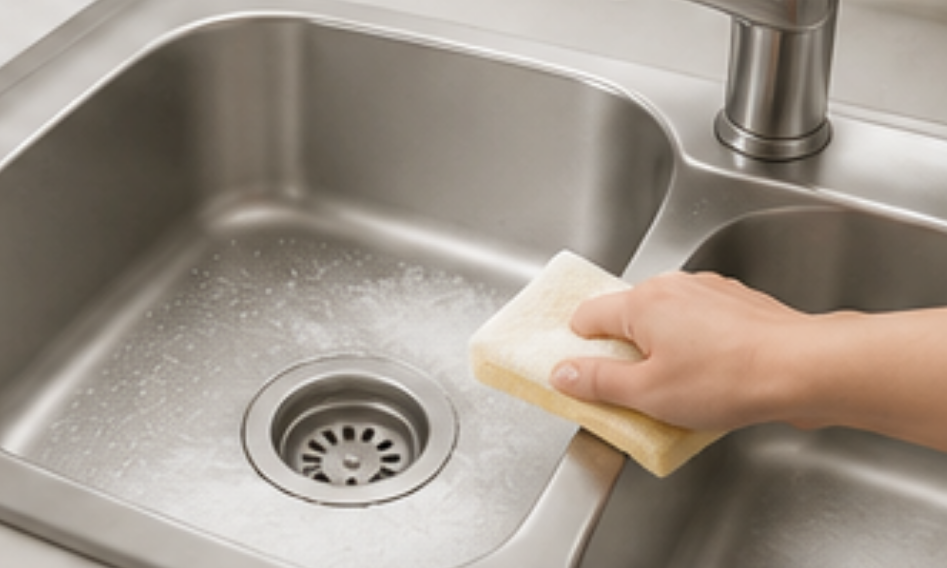
Leave the stainless steel surface slightly damp, then sprinkle a thin, even layer of baking soda over the bowl.
Use a soft sponge or microfiber cloth to rub gently in the direction of the stainless steel grain.
Brushed stainless steel has a visible directional texture.
Moving along the grain helps reduce the chance of creating obvious cross-grain marks.
For a local stain, mix baking soda with a small amount of water.
Apply the paste to the affected area and leave it briefly. Wipe gently with a soft cloth, then rinse.
Do not allow the paste to dry into a hard crust, as removing it may require unnecessary scrubbing.
Flush the complete bowl with clean water.
Baking soda residue can dry into a white film around the drain, corners, and rim. Pay attention to welded seams and accessory ledges.
Drying helps prevent new water spots and makes the cleaned finish easier to inspect.
Use a clean microfiber cloth and continue wiping along the grain.
Do not create random mixtures of baking soda, bleach, drain cleaner, ammonia, or other household chemicals.
Although baking soda and vinegar are often combined for visible foaming, the reaction largely neutralizes the acid and base. The bubbling may help move loose debris in some situations, but it is not a substitute for correct cleaning or drain maintenance.
Use a soft brush around the drain flange and basket strainer.
Avoid pushing large amounts of baking soda into the plumbing. A blocked or slow drain may require mechanical cleaning or professional service rather than repeated household mixtures.
Baking soda may remove transferred metal marks or residue that looks like a scratch, but it cannot refill damaged stainless steel.
Deep scratches require professional refinishing or may remain visible as part of normal sink use.
Baking soda may alter the patina or leave an uneven bright area. Use the copper-sink manufacturer’s recommended method.
Stone sinks may require a pH-neutral cleaner and approved sealing maintenance.
Repeated abrasion can affect the color or protective surface. Follow the product instructions before using powders.
A 304 Stainless Steel Sink combines corrosion resistance with a practical surface for kitchen use, but the finished performance also depends on sheet quality, manufacturing, welding, finishing, installation, and maintenance.
Baking soda can support light cleaning when used correctly, but chlorine residue, strong acids, carbon-steel contamination, and abrasive tools should still be avoided.
Our factory carefully selects stainless steel to support durability and dimensional stability.
The production system includes in-house processing, multiple production lines, quality supervision, and export packaging. Our facility is designed to support high-volume manufacturing together with customized sink requirements.
Developing stainless steel sinks for cabinet suppliers, retailers, apartments, hotels, or kitchen projects?
Send us the sink dimensions, bowl quantity, steel thickness, installation method, finish, drainage structure, accessories, packaging requirements, and order quantity. We will prepare a 304 Stainless Steel Sink proposal.